

Heating, batteries, travel
How Soleilwear heated clothing works
A heated vest is a garment with a small electric circuit sewn in and a power bank in the pocket. Here is how ours are laid out, what the button does, and how to look after the battery.
Where the heat sits
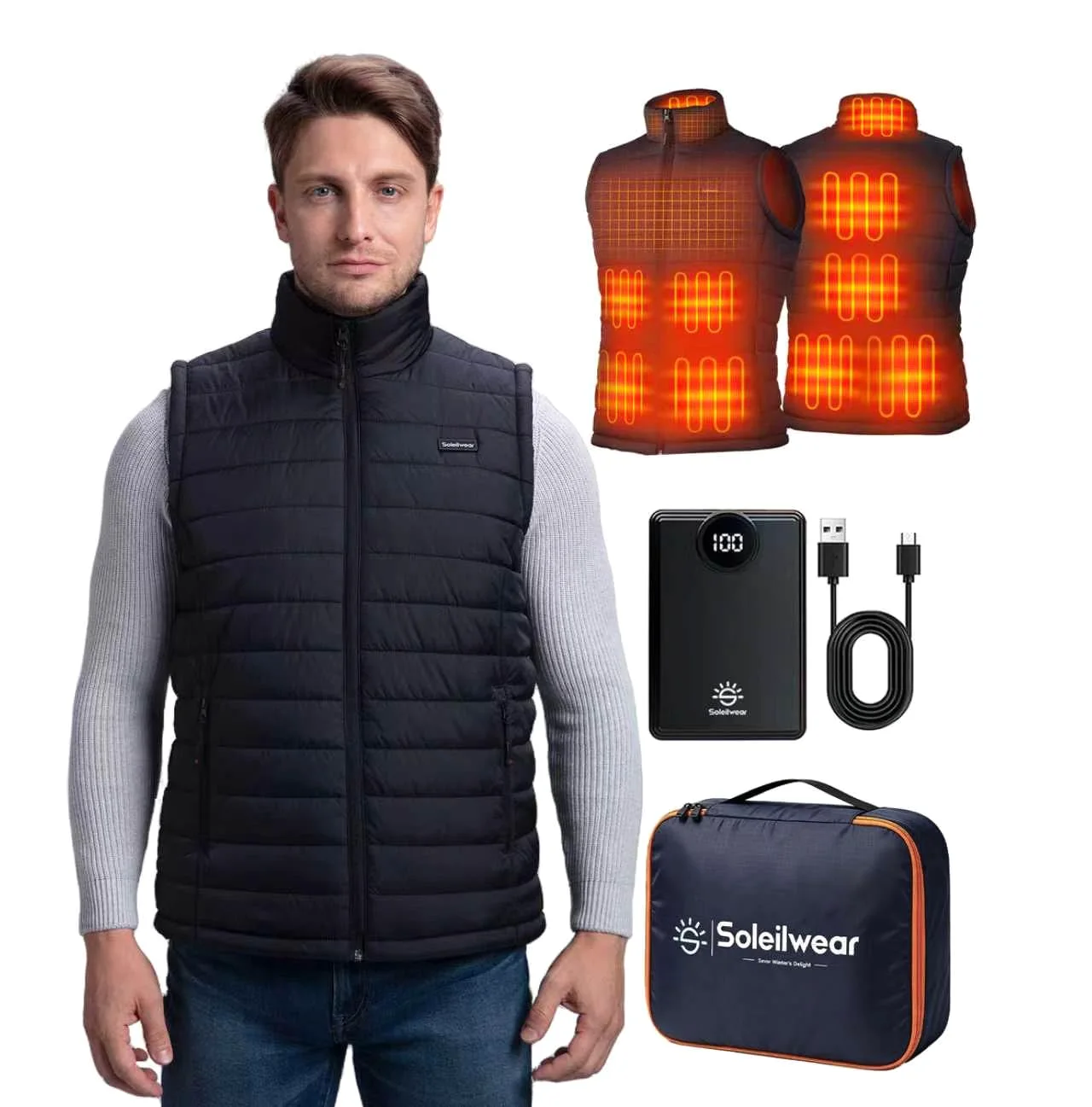
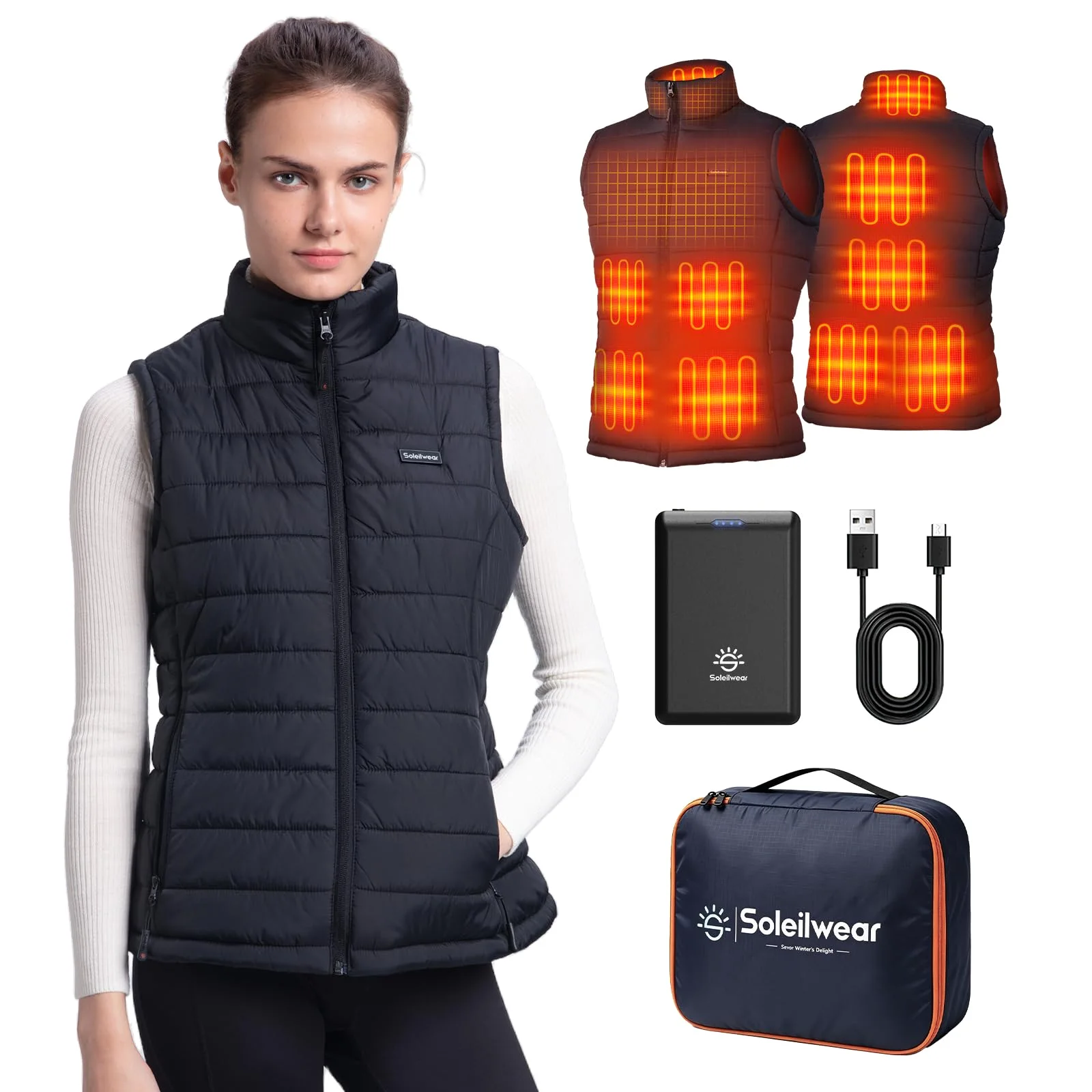
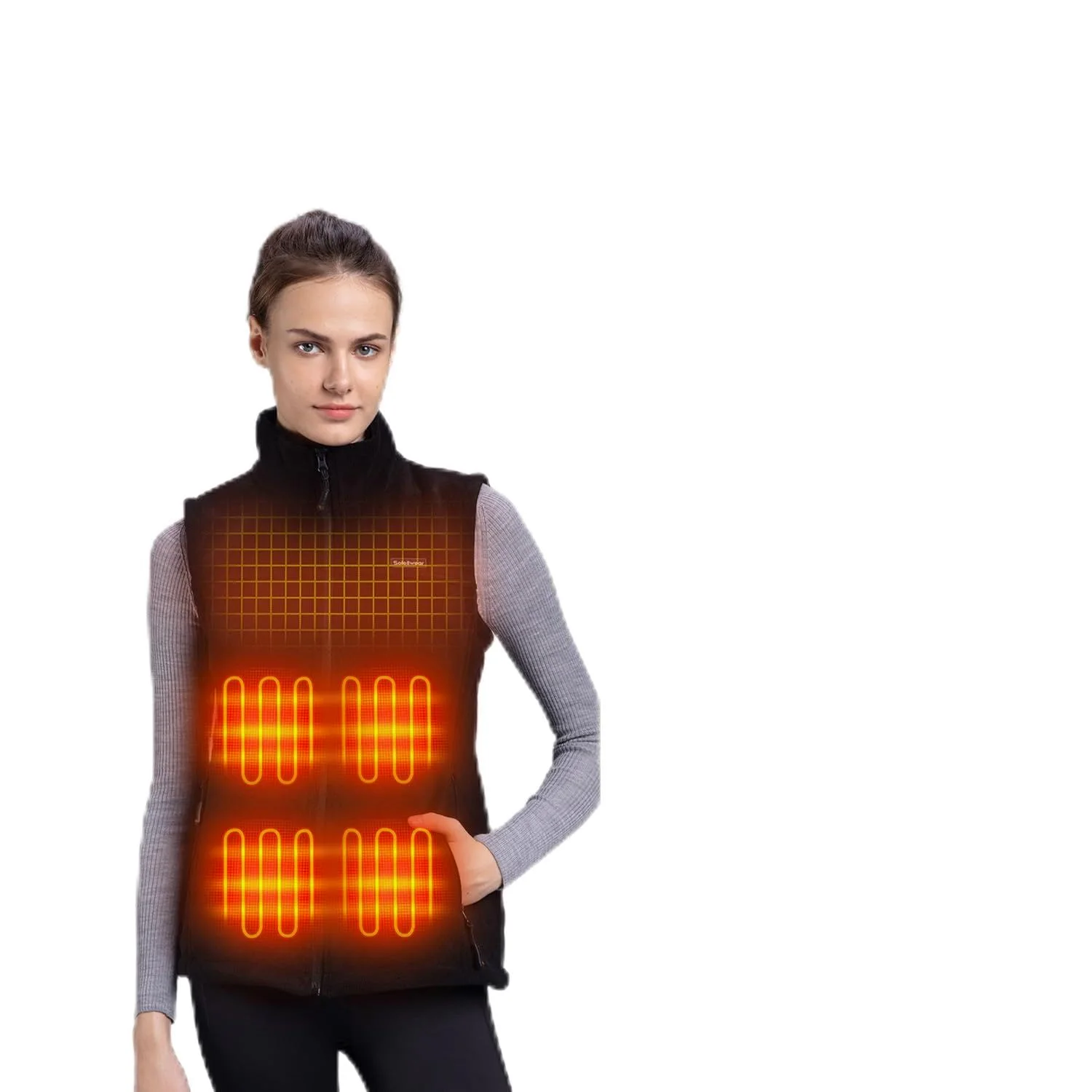
Our vests carry nine carbon-fiber panels: one at the back of the neck, one across the middle of the back, one on each side of the lower back, and a group around and above the two zippered hand pockets. The fleece vest places its nine panels at the neck, the chest, the middle and lower back, and around the hand pockets. The jacket uses six graphene panels instead, at the abdomen, the upper arms, the back and the neck on the men's coat.
The glowing shapes you see on some of our photographs are drawn on to show where the panels sit. They are a map, not a thermal camera.
One button, three settings
The logo on the left chest is the switch. Hold it for three seconds to turn the heat on or off, and use the same button to set the level: Low at 104°F, Medium at 122°F or High at 140°F. The temperatures are our panel settings, the same on every vest and on the jacket.
A higher setting draws the bank down faster. Start on Low and step up if you need to. The hours in the table below show what each step costs.
How long a charge lasts
Runtime depends on the setting and on the bank. We print only the figures we publish for each garment: the puffer vests are rated at up to 10 hours on their bank, and the men's jacket lists the hours for each setting. The fleece vests carry no runtime rating, so on a long day in one, bring the spare bank.
| Garment | Battery in the box | Runtime we publish |
|---|---|---|
| Lightweight puffer vests | 10,000 mAh, 5V | up to 10 hours |
| Fleece vests | 10,000 mAh, 5V | not published |
| Graphene jacket (men's) | 16,000 mAh, 7.4V | 12 h Low, 8 h Medium, 6 h High |
| Graphene jacket (women's) | 16,000 mAh, 7.4V | up to 12 hours |
The three power banks
The vests run on 5V banks, and the jacket runs on a 7.4V pack. That voltage is the one number to check before you buy a spare: a 5V bank does not replace the jacket pack.
| 10,000 mAh bank | 12,000 mAh spare | 16,000 mAh pack | |
|---|---|---|---|
| Voltage | 5V | 5V | 7.4V |
| Comes with | every vest | sold on its own and in the fleece set | the graphene jacket |
| Outputs | two USB ports | two USB, 5V 2.4A each | to the jacket, USB-C cable in the box |
| Charging in | cable in the box | USB-C, 5V 2.1A | USB-C, PD fast charging on the men's coat |
| Size and weight | not published | 3.5 × 2.5 × 1 in, 0.39 lb | not published |
| Hours of heat | up to 10 in the puffer vests | not published | 12 Low, 8 Medium, 6 High (men's coat) |
Charging and storing a bank
Charge a bank with the cable that came with it, on a hard surface rather than on a bed or a sofa, and unplug it once it is full. Keep it out of direct sun and out of a hot car in summer. The Seattle Fire Department gives the same advice for every lithium-ion battery, and adds two more: stop using a battery that swells, leaks, smells or runs hot, and never throw one in the trash.
Between seasons, store the vest clean and dry and keep the bank separately somewhere cool and dry.
Flying with a heated vest
A power bank always goes in your carry-on. The TSA says so plainly, and the FAA adds that if your cabin bag is checked at the gate, the bank comes out and stays with you. The vest itself, with the bank removed, can travel in either bag.
The FAA limits a rechargeable battery to 100 watt hours without airline approval. With approval, you may carry up to two spares between 101 and 160 Wh. Watt hours are volts times amp hours. Read the Wh figure printed on your bank first. If the label gives only mAh and volts, divide the mAh by 1,000 and multiply by the volts on that same label: 10,000 mAh at 3.7V is 37 Wh. For a 7.4V pack the same sum gives a bigger number, so check the label of a jacket pack before you fly and ask your airline if it is over 100.
Wearing it in real cold
CDC NIOSH advises several layers of loose clothing in the cold, with the ears, face, hands and feet covered and a hat on. A heated vest fits that advice as a middle layer: a base layer under it, the vest, and a shell over it when it rains or blows. Leave a little room under the shell: the same NIOSH page warns that some clothing restricts movement.
Washing
Take the bank out of the inner pocket and tuck the cable in before washing. Our vests and the jacket are machine washable, and the manual in the box gives the cycle and the drying steps.
Each garment's page has its own figures, held to the Soleilwear approach, so you see only what we publish for that garment.
